AOICRIE V1.1.0 Power Shield Wemos Mini Development 701715535671 12PCS D1
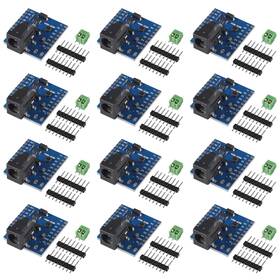
( Brand: Aoicrie ), ( Itemheight: 25 ), ( Itemlength: 28 ), ( Packageheight: 50 ), ( Packagelength: 179 ), ( Packagewidth: 108 ), ( UPC: 701715535671 )
Review AOICRIE 12pcs Dc Power Shield Wemos D1 Mini Development
The **AOICRIE 701715535671 12-Piece Power Shield V1.1.0 for Wemos D1 Mini Development Board** is a meticulously engineered accessory designed to enhance the functionality and reliability of the Wemos D1 Mini, a popular ESP8266-based microcontroller platform. This versatile power shield serves as a comprehensive solution for managing and optimizing power distribution, protection, and connectivity in embedded projects, making it an indispensable tool for hobbyists, engineers, and developers working on IoT applications, home automation systems, or custom electronics prototypes. The shield features a robust **12-pin layout**, including a combination of voltage regulators, protection circuits, and mounting points that seamlessly integrate with the Wemos D1 Mini s GPIO pins, headers, and power rails. At its core, the Power Shield V1.1.0 incorporates a **high-efficiency voltage regulator** capable of stabilizing and delivering clean, consistent power to sensitive components, mitigating issues like voltage spikes, noise, or fluctuations that could otherwise compromise the performance of your project. This is particularly critical when powering external sensors, actuators, or other peripherals that may draw varying current loads, as the shield ensures stable operation across a wide range of applications.
Beyond power regulation, the shield includes **reverse polarity protection**, **overcurrent protection**, and **short-circuit prevention** mechanisms, safeguarding both the Wemos D1 Mini and connected devices from potential damage due to electrical mishaps. These protective features are implemented with precision, allowing users to confidently prototype and deploy projects without constant worry about power-related failures. The design also incorporates **easy-access mounting holes** and a **compatible footprint** for the Wemos D1 Mini, ensuring a snug and secure fit that minimizes wiring clutter and maximizes board space efficiency. Additionally, the shield s **modular and expandable layout** accommodates a variety of power sources, including 5V or 3.3V inputs, as well as external power modules or batteries, providing flexibility for different project requirements. Whether you're working on a battery-powered sensor network, a high-current motor driver setup, or a low-power data logging system, the Power Shield V1.1.0 offers a reliable foundation to streamline your development process.
For developers focused on **IoT and wireless applications**, the shield s integration with the Wemos D1 Mini s ESP8266 chipset ensures seamless compatibility with Wi-Fi and Bluetooth connectivity, allowing for effortless communication with cloud platforms, local networks, or other devices. The inclusion of **dedicated power rails and decoupling capacitors** further enhances signal integrity and reduces electromagnetic interference, which is essential for maintaining stable wireless performance. The shield s **clear labeling and organized pinout** make it ideal for both beginners and experienced developers, as it simplifies the process of connecting sensors, LEDs, relays, or other components without the need for complex soldering or external power management circuits. With its **durable PCB construction** and **high-quality components**, the AOICRIE Power Shield V1.1.0 is built to withstand repeated use in both laboratory and field environments, offering long-term reliability for your projects. Whether you're building a smart home device, a weather station, or an experimental robotics platform, this power shield transforms the Wemos D1 Mini into a more capable and versatile development tool, empowering creators to focus on innovation rather than power management challenges.
The **AOICRIE 701715535671 (12PCS Power Shield V1.1.0 for Wemos D1 Mini)** is a popular add-on board designed to enhance the power management and functionality of the Wemos D1 Mini. Below is a detailed breakdown of its pros and cons, followed by a conclusion and recommendation.
---
### **Pros**
1. **Enhanced Power Management**
The shield includes a **TP4056 lithium battery charger module**, allowing you to power the Wemos D1 Mini via a **18650 lithium-ion battery** (included) or an external power source. This eliminates the need for constant USB power and extends battery life for portable projects.
2. **Multiple Power Input Options**
- **USB Power (5V)**: Standard micro-USB input for direct power from a USB source.
- **External Power (5V-12V)**: Supports a wider voltage range (via the DC jack), making it suitable for projects requiring higher voltage stability.
- **Battery Power**: The included 18650 battery provides portable operation, useful for IoT sensors, wearables, or remote monitoring devices.
3. **Built-in Protection Circuits**
The shield includes **overcharge, over-discharge, and short-circuit protection** for the lithium battery, ensuring safe operation and prolonging battery life.
4. **LED Indicators**
There are **three LEDs** (power, charging, and battery status) that provide visual feedback on the system s state, which is helpful for troubleshooting.
5. **Easy Integration with Wemos D1 Mini**
The shield is designed to **stack directly** on top of the Wemos D1 Mini without requiring additional wiring for basic functionality. It uses the same GPIO pins, so most existing code will work with minimal adjustments.
6. **Cost-Effective**
At around **$10 $15**, it is relatively affordable compared to other power management solutions that offer similar features.
7. **Supports Multiple Power Sources Simultaneously**
You can **switch between USB, external DC power, and battery power** without needing to modify the hardware, offering flexibility for different project requirements.
8. **Comprehensive Documentation**
AOICRIE provides **schematics, wiring diagrams, and basic usage guides**, making it accessible for beginners while still useful for experienced users.
9. **Compact and Modular Design**
The shield is small and fits neatly on the Wemos D1 Mini, making it ideal for projects with limited space.
10. **Compatible with Arduino IDE**
Since it works seamlessly with the Wemos D1 Mini (which is Arduino-compatible), developers familiar with Arduino can easily integrate it into their projects.
---
### **Cons**
1. **Limited Current Handling**
The **TP4056 module** has a **maximum charging current of 1A**, which may be insufficient for high-power projects or if multiple high-current peripherals are connected. This could lead to slower charging or overheating under heavy loads.
2. **No Built-in Buck-Boost Converter**
The shield does not include a **buck-boost converter**, meaning it cannot efficiently regulate voltages outside the **5V 12V range** for the DC input. If you need to power the Wemos D1 Mini from a lower voltage (e.g., 3.3V or 6V), you ll need an external regulator.
3. **No USB Power Regulation**
While the shield can take power from USB, it does not **regulate or step down** the voltage for peripherals that require lower voltages (e.g., sensors or LEDs). You may need additional components (like a voltage divider or LDO regulator) for such cases.
4. **Potential for Voltage Drop**
If the **external DC input is too low (e.g., 5V but unstable)**, the Wemos D1 Mini may experience **voltage fluctuations**, leading to unstable operation. A stable power source (e.g., 7 12V) is recommended.
5. **No Built-in Voltage Measurement**
There is **no built-in ADC or voltage divider** to measure the battery voltage programmatically. If you need to monitor battery levels in real-time, you ll have to wire an external sensor or use an external ADC.
6. **Limited GPIO Availability**
While most GPIOs remain accessible, some pins (e.g., **D1, D2, D5, D6**) may be used internally by the shield for charging or power management. Users must check the **schematic** to avoid conflicts with their project s I/O requirements.
7. **Quality Control Variability**
Some users report **inconsistent soldering or minor component issues** (e.g., loose connections on the DC jack or battery holder). Buying from a reputable seller (e.g., AliExpress, Amazon, or official distributors) can mitigate this risk.
8. **No Built-in Current Limiting for Peripherals**
If you connect high-current peripherals (e.g., motors, high-power LEDs) directly to the Wemos D1 Mini, the shield does not provide **current limiting**, which could damage the board or battery.
9. **Limited Documentation for Advanced Use**
While basic usage is well-documented, **advanced features** (e.g., custom power management firmware or deep integration with battery monitoring) require additional research.
10. **No Built-in Sleep Mode Optimization**
The shield does not include **low-power sleep mode optimizations** (e.g., automatic shutdown when battery is low). Users must implement this manually in their code.
---
### **Conclusion**
The **AOICRIE Power Shield V1.1.0 for Wemos D1 Mini** is a **versatile and cost-effective** solution for projects requiring **portable or multi-source power**. It excels in **simplifying power management** for beginners and offering **flexibility in power inputs**, making it ideal for **IoT sensors, battery-powered devices, and portable automation projects**.
However, it has **limitations in high-current applications, voltage regulation, and advanced monitoring**, which may require **additional components or workarounds**. If your project involves **low-power consumption, basic battery operation, or USB/DC-powered setups**, this shield is an excellent choice. For **high-power, voltage-sensitive, or highly automated projects**, you may need to supplement it with **external regulators, ADCs, or current-limiting circuits**.
---
### **Recommendation**
**Buy this shield if:**- You need a **simple, affordable way to add battery power** to your Wemos D1 Mini projects.
- Your project **does not require high current draw** (e.g., motors, high-power LEDs).
- You want **multiple power input options** (USB, DC, or battery) without complex wiring.
- You are a **beginner or intermediate user** looking for an easy-to-integrate power solution.
**Avoid or supplement this shield if:**- Your project requires **stable low-voltage regulation** (e.g., 3.3V for sensors). Consider adding an **LDO regulator** (e.g., AMS1117).
- You need **high-current charging** (e.g., for multiple 18650 batteries). A **higher-current charger module** (e.g., 2A ) may be necessary.
- You want **real-time battery monitoring**. Add an **external ADC (e.g., MCP3008)** or use a **separate battery management IC**.
- Your project involves **sleep modes or deep power optimization**. Implement this in your **Arduino code** or use an **external low-power controller**.
**Best Use Cases:****IoT sensors** (e.g., temperature/humidity, soil moisture) running on battery.
**Portable automation** (e.g., smart home devices with wireless connectivity).
**Low-power prototyping** where USB/DC power is occasionally used.
**Educational projects** teaching basic power management concepts.
**Alternatives to Consider:**- **For high-current projects**: Use a **separate buck-boost converter** (e.g., MT3608) alongside the shield.
- **For advanced battery monitoring**: Pair with a **Battery Management System (BMS)** or external ADC.
- **For stable 3.3V output**: Add an **LDO regulator** (e.g., AMS1117-3.3) to the shield s output.
---
**Final Verdict:** The **AOICRIE Power Shield V1.1.0** is a **solid choice for most Wemos D1 Mini power needs**, especially for beginners and low-to-medium power applications. With minor additions (e.g., regulators, ADCs), it can be extended for more complex projects. If your requirements align with its strengths, it is **highly recommended**. Otherwise, plan for supplementary components to meet advanced needs.
Details:
7-24 Volt DC Input; 5/1 Output; Low Quiescent Current of about 0.9ma. Size: 2.8x2.5cm/1.10x0.98 inch. Header pins and screw terminal block are included for optional soldering to board if needed. AOICRIE 12pcs DC Power Shield V1.1.0 for WEMOS D1 Mini Development Board Supply Screen Module.
12pcs for WEMOS D1 Mini DC Power Shield V1.1.0 Development Board. DC input can be directly soldered, attached via included screw terminals, or plugged in with the barrel jack. Great for many projects, including WLED builds and ESP-HOME devices.
part #: 701715535671 price
- $25.07
specifications monitopowsup:
- brand: Aoicrie
- itemheight: 25
- itemlength: 28
- packageheight: 50
- packagelength: 179
- packagewidth: 108
- upc: 701715535671
seller monitopowsup:
- city: Hollywood, Florida
- rating: 97.9%
- # reviews: 463
shipping monitopowsup:
- transit: 3-5 Days
- service: Expedited
- class: Expedited
- type: Fixed
- cost: $0.00
returns monitopowsup:
- policy: No Returns
offer monitopowsup:
- sold: 0
- quantity: 1
- started: April 28, 2026
- options: Ship-to-home
- availability: In Stock
general monitopowsup:
- condition: New
- Computers/Tablet's Networking > Monitors, Projectors Accs > Monitor Power Supplies
payments monitopowsup:
- other
- credit card: Visa
- wallet: Paypal